Free, open-source tools for scientists who take Earth's motion seriously.
Compute, visualize, and export the hidden dynamics of any location on Earth.
As stated in our Mission statement - our goal is to bring a new paradigm to biology by finishing the Copernican revolution. Every mass on Earth is embedded in a complex, periodic acceleration field driven by our planet's spin, lunar gravity, and solar orbit. These motions produce real, calculable strain cycles — jerk, snap, and higher-order dynamics that oscillate with diurnal, lunar, and annual periodicities.
CHECK OUT OUR FIRST TOOL: The Earth Frame Calculator — it makes these invisible dynamics visible! Enter any location on Earth and instantly see the velocity fields, accelerations, and strain periodicities that every molecule at that location experiences — dynamic factors acting on cells that has traditionally been ignored.
Enter a location to compute its dynamical environment.
Install with pip install copernican-toolkit and compute Earth-bound dynamics in 3 lines of code. Includes Jupyter notebooks, visualization tools, and full API documentation.
Native R package for the biostatistics community. Compute frame dynamics and export data directly into your R analysis pipeline. Compatible with tidyverse workflows.
GitHub →Use earthframe from any AI assistant (Claude, ChatGPT, Cursor) via the Model Context Protocol. Ask questions in natural language and get computed dynamics back instantly.
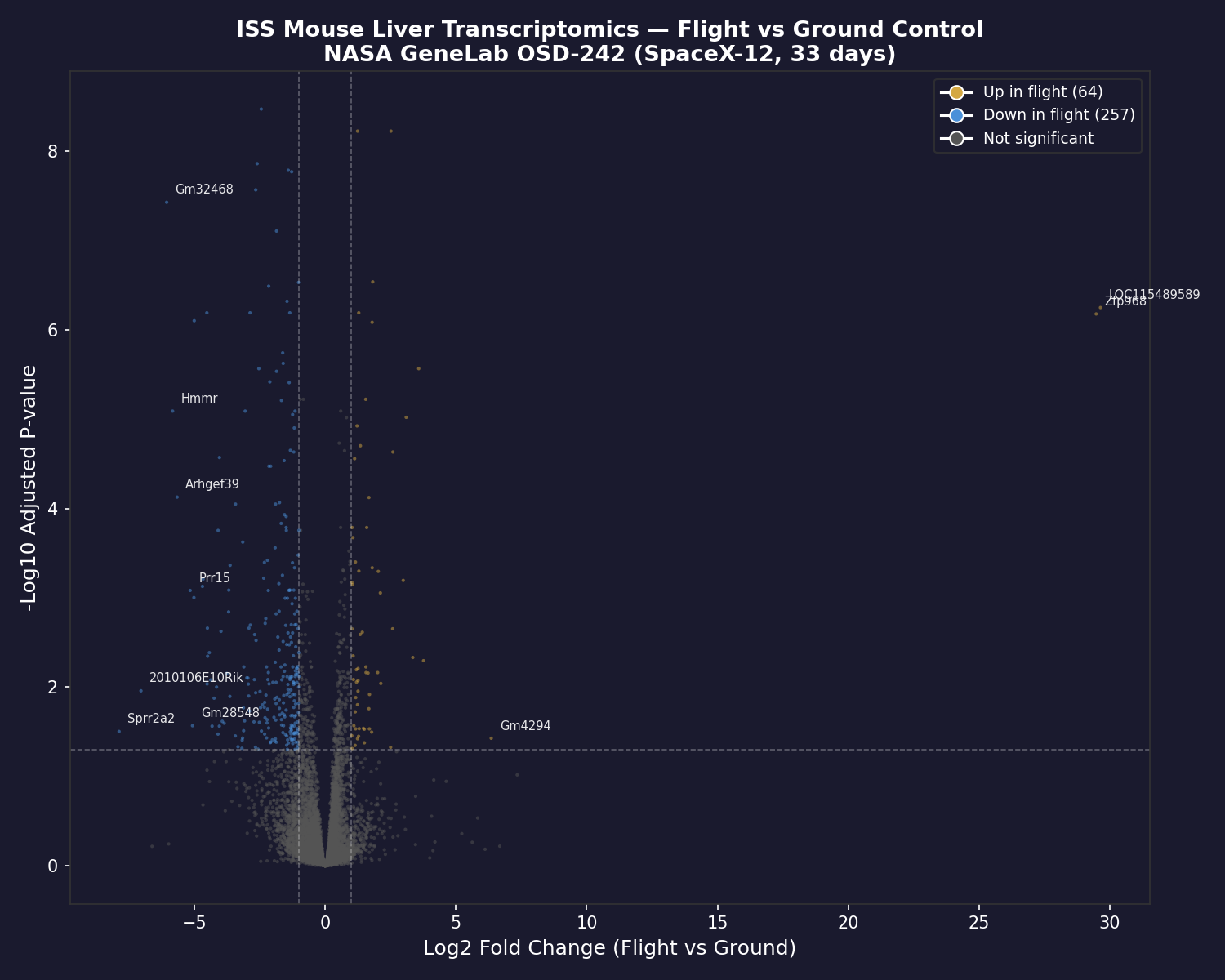
GitHub →We applied the Copernican Toolkit to real spaceflight biology data from NASA GeneLab (OSD-242) — mouse liver transcriptomics from the SpaceX-12 mission (33 days on the ISS).
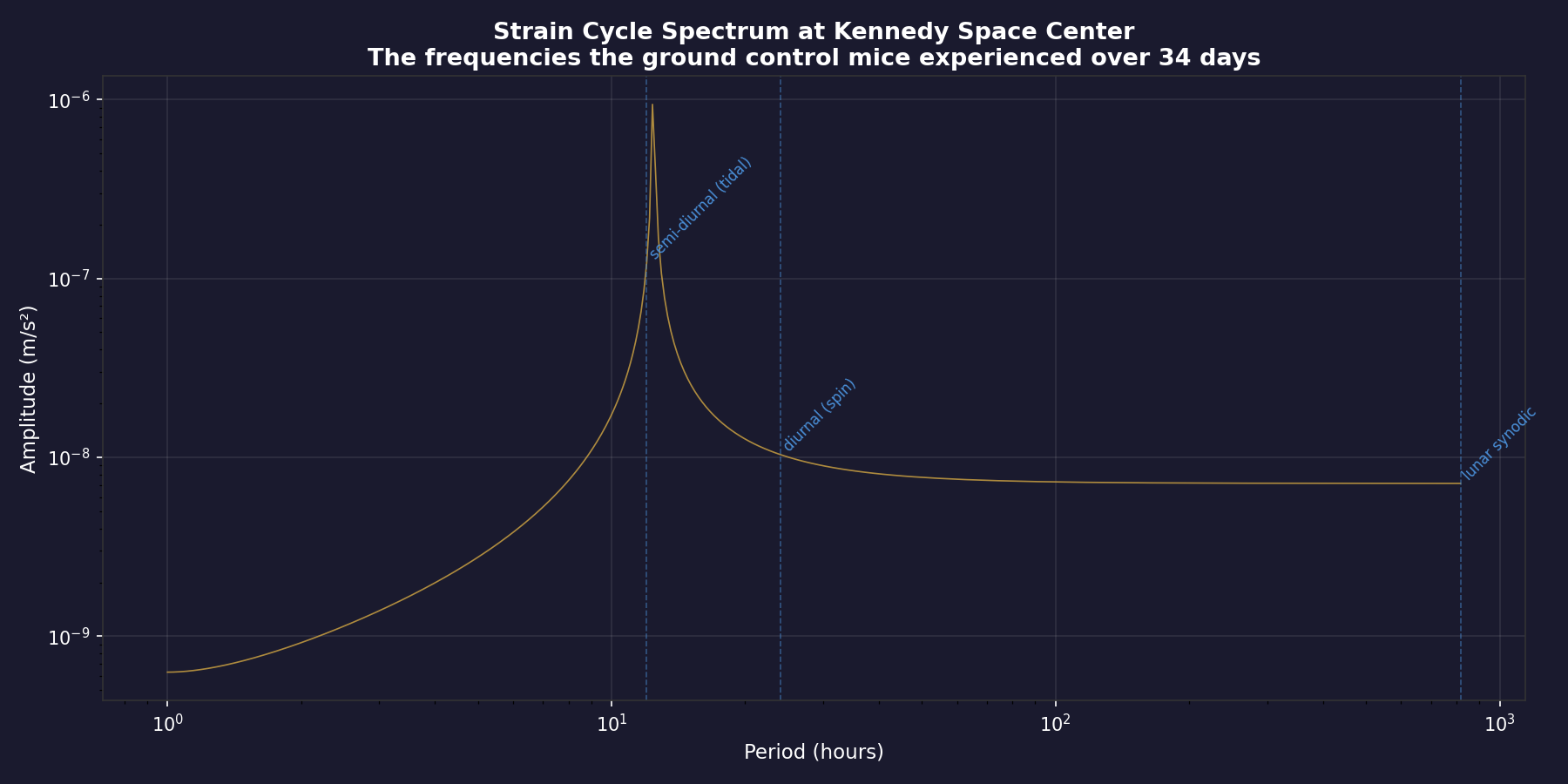
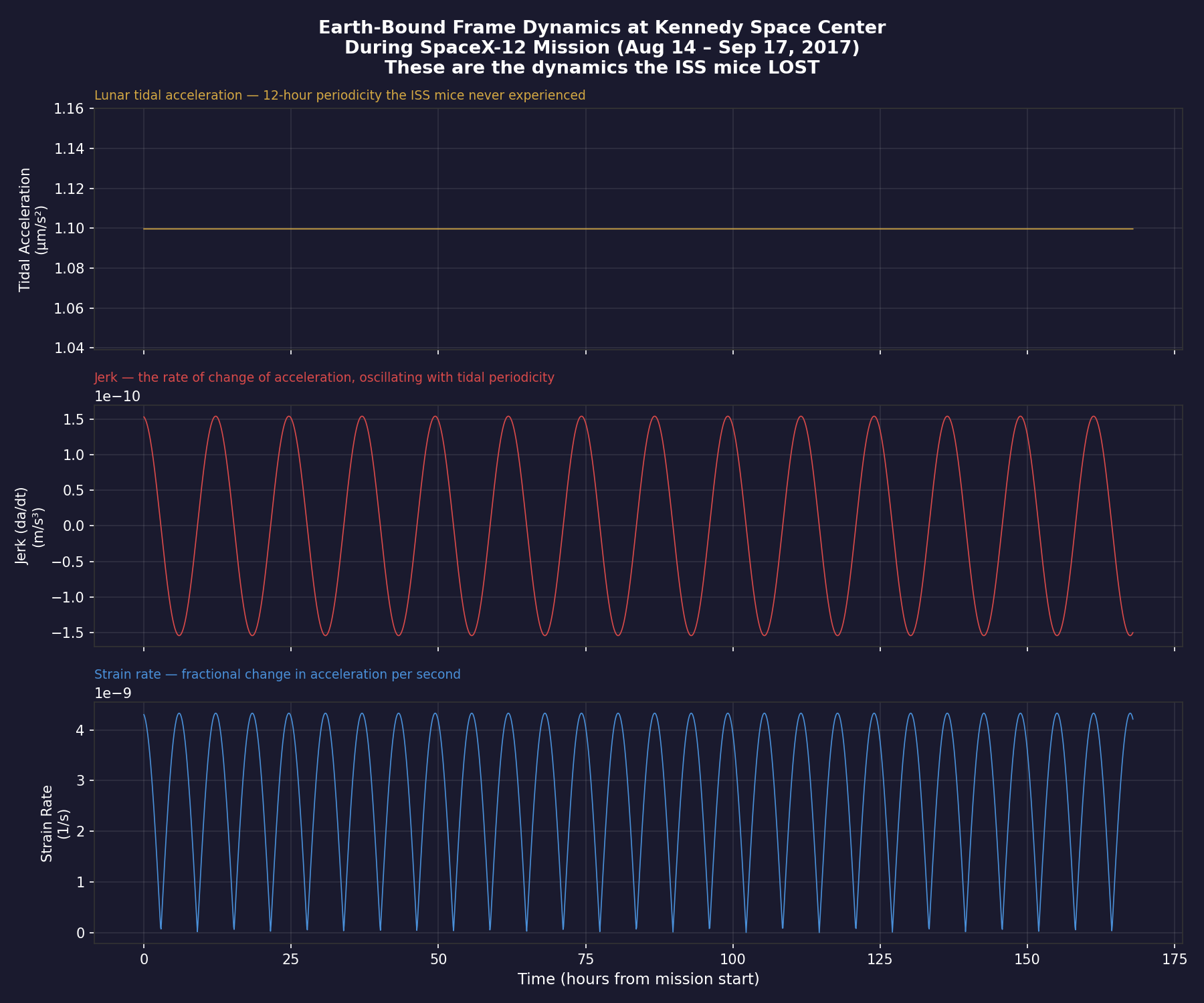
The ground control mice at Kennedy Space Center experienced rich, periodic acceleration dynamics — with dominant strain cycles at ~12 hours driven by lunar tidal forces. The ISS mice lost these dynamics entirely.
The result: 321 genes were significantly differentially expressed — 257 downregulated in flight. The disrupted pathways include circadian clock genes (Nr1d1, Nr1d2, Npas2, Rorc), oxidative stress response, lipid and glucose metabolism, and immune function.
These are exactly the pathways that would be modulated by the 12-hour and 24-hour strain periodicities our toolkit quantifies. The ISS mice didn't just lose "gravity" — they lost the periodic dynamics embedded in Earth's reference frame.
| Pathway | Key Genes | Direction |
|---|---|---|
| Circadian Clock | Nr1d1, Nr1d2, Npas2, Rorc | ↑↓ Mixed |
| Oxidative Stress | Nqo1 ↑↑↑, Gstp1, Gstm4, Gsta3 | Reshuffled |
| Glucose Metabolism | Pck1 (gluconeogenesis), Pfkl (glycolysis) | ↑ Upregulated |
| Lipid Metabolism | Ppargc1a, Srebf2 | ↑ Upregulated |
| Immune Response | Il1b ↓↓, Cxcl9 ↓↓↓ | ↓ Suppressed |
Full analysis script and data available in the GitHub repository. Data source: NASA OSDR OSD-242 (open access).
| Module | Description | Status |
|---|---|---|
| earthframe | Earth-bound reference frame dynamics | ✓ Released |
| periodicity | Detect circadian, circalunar, and annual cycles in biological data | In Development |
| isomerdb | Nuclear isomeric states database at biological energies | Planned |
| isotope-tools | Heavy isotope fractionation analysis for metabolic studies | Planned |
| spacebio | Biological data analysis for altered-gravity environments | Planned |