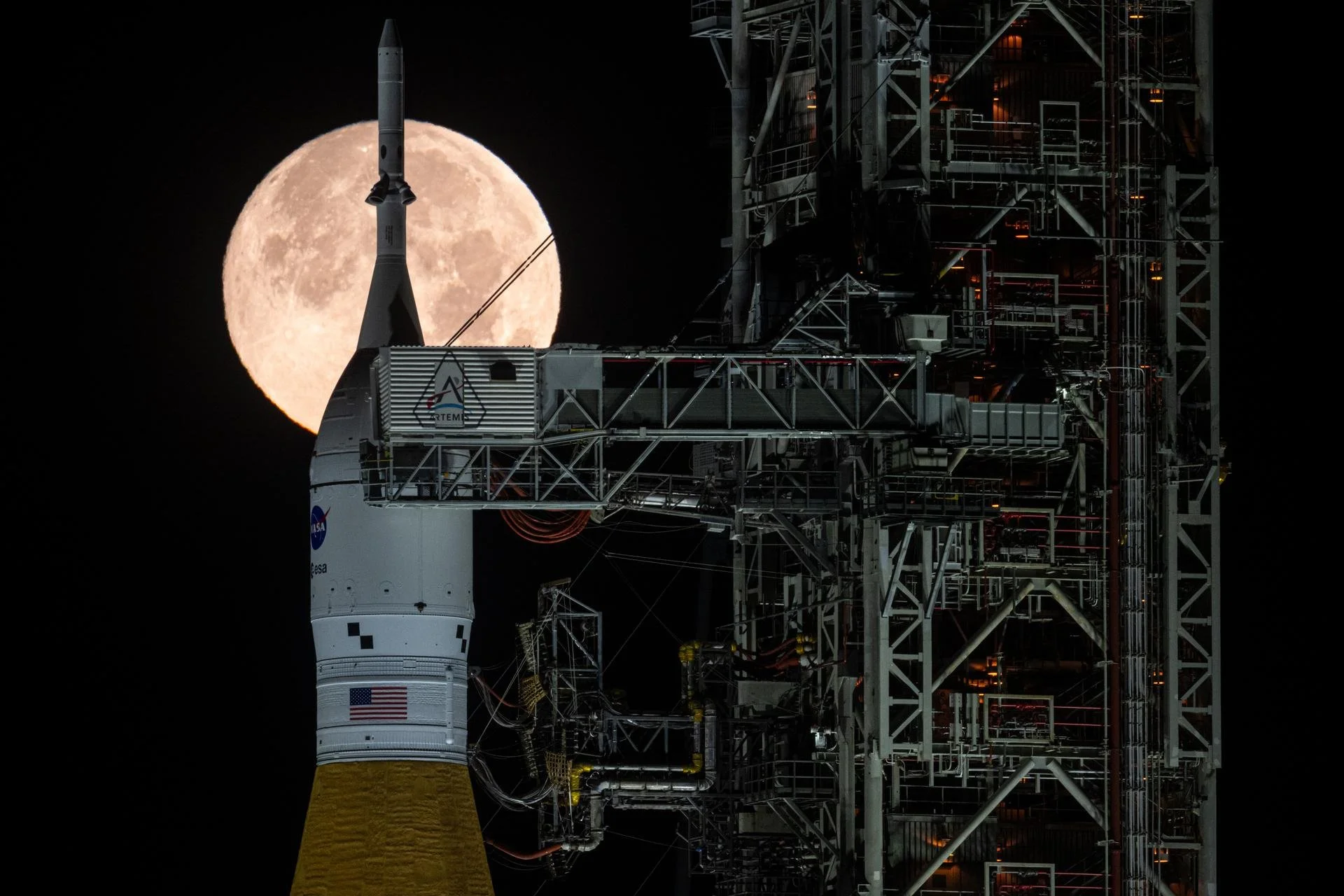
NASA's Artemis program will return humans to the Moon — targeting the lunar south pole for the first crewed landing since 1972. What does the non-inertial dynamic environment look like at those landing sites? And how does it differ from what human biology evolved in? We've used our EarthFrameTM Calculator to run a comparison of the dynamics a typical astronaut will experience when living on the Moon versus when they were at home on Earth.

MOON vs. HOME
NASA identified 13 candidate landing regions all within 6° of the lunar South Pole — we've picked Haworth.
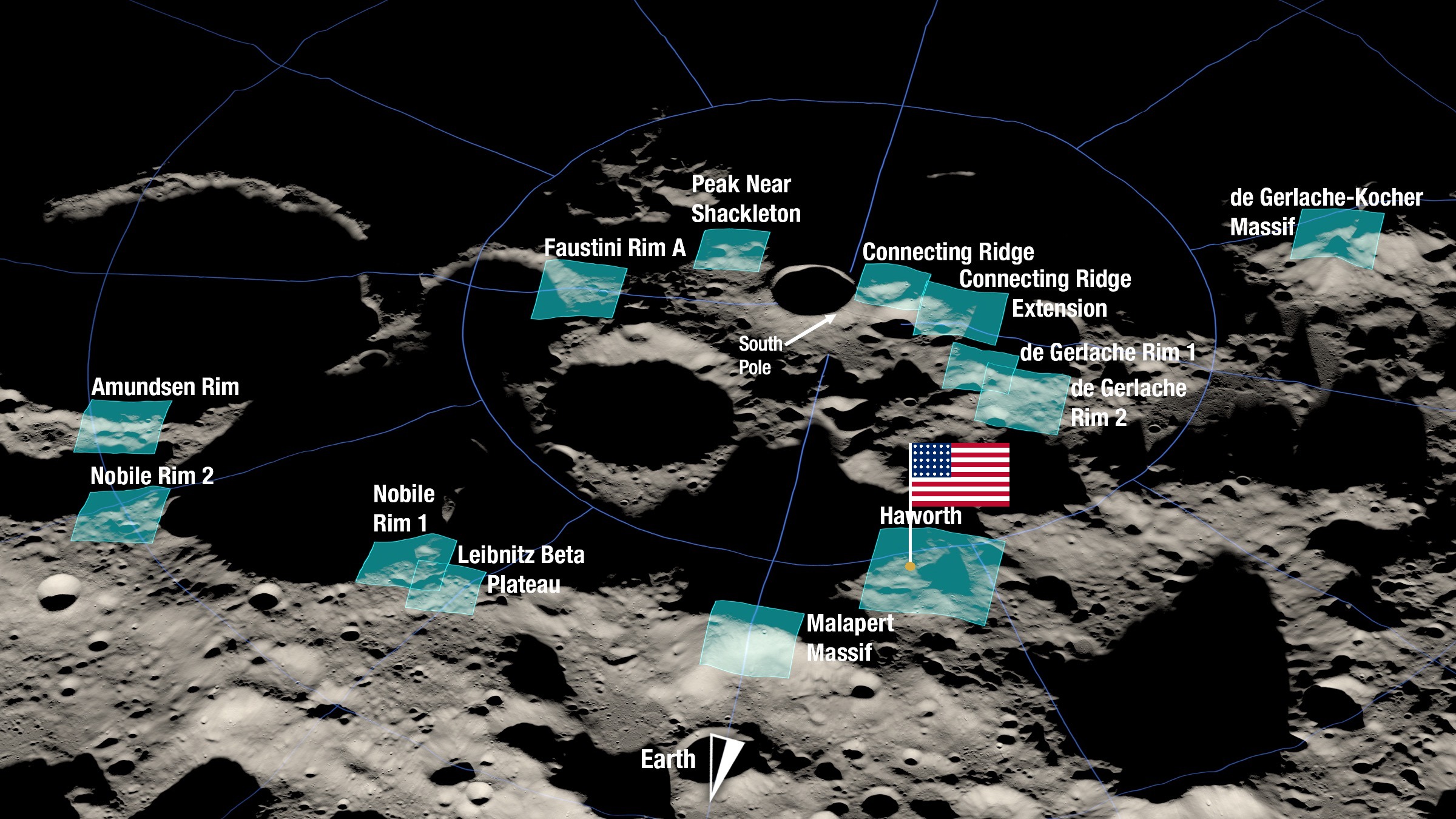
NASA's candidate landing regions near the lunar south pole. Haworth site marked. Credit: NASA
The following plots show the dynamics acting on a 68 kg astronaut over one complete lunar month (27.3 days) — the Moon's fundamental cycle.
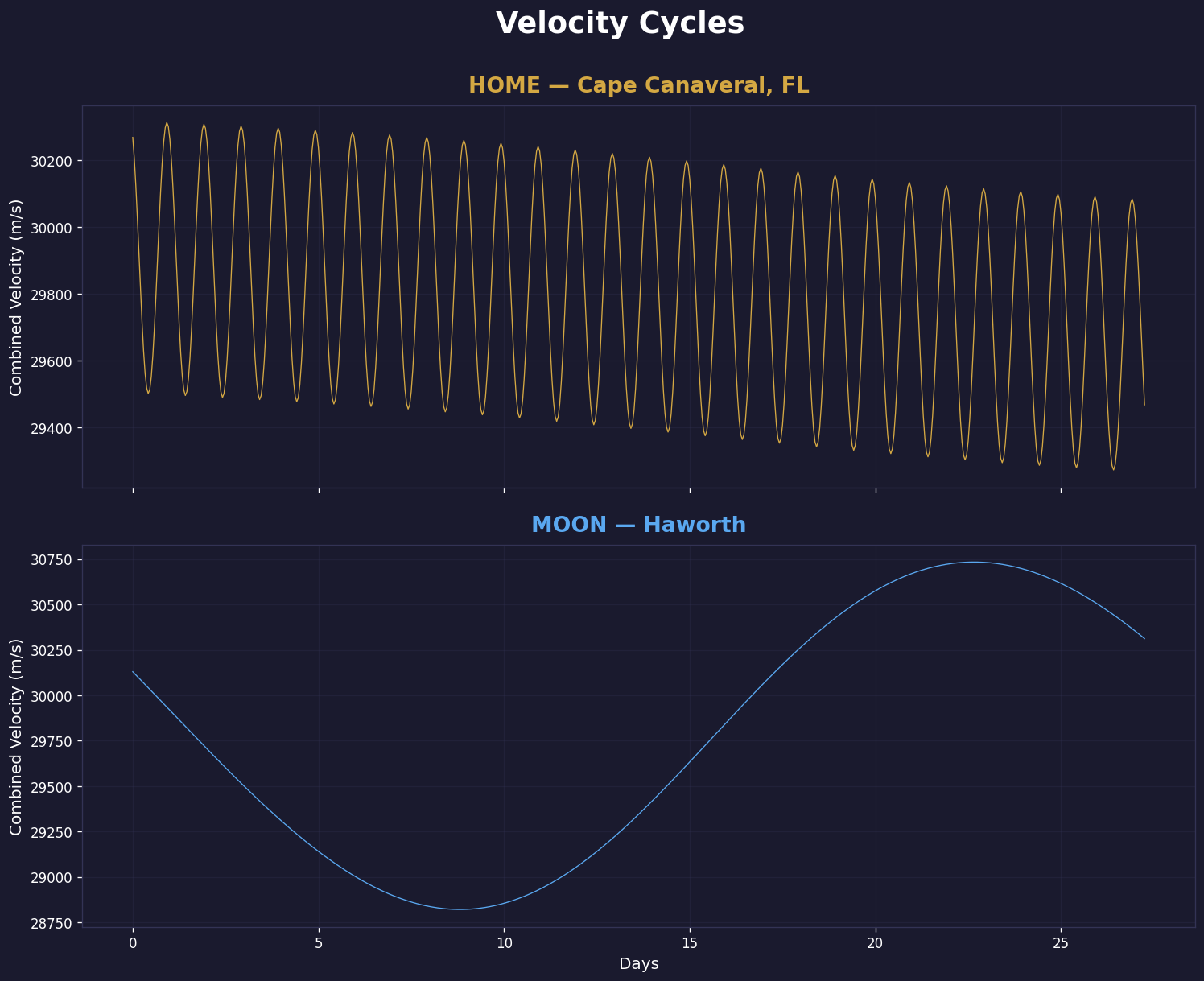
Combined tangential velocity. Earth's daily spin creates the rapid oscillation. The Moon's velocity varies smoothly over the month as orbital geometry changes.
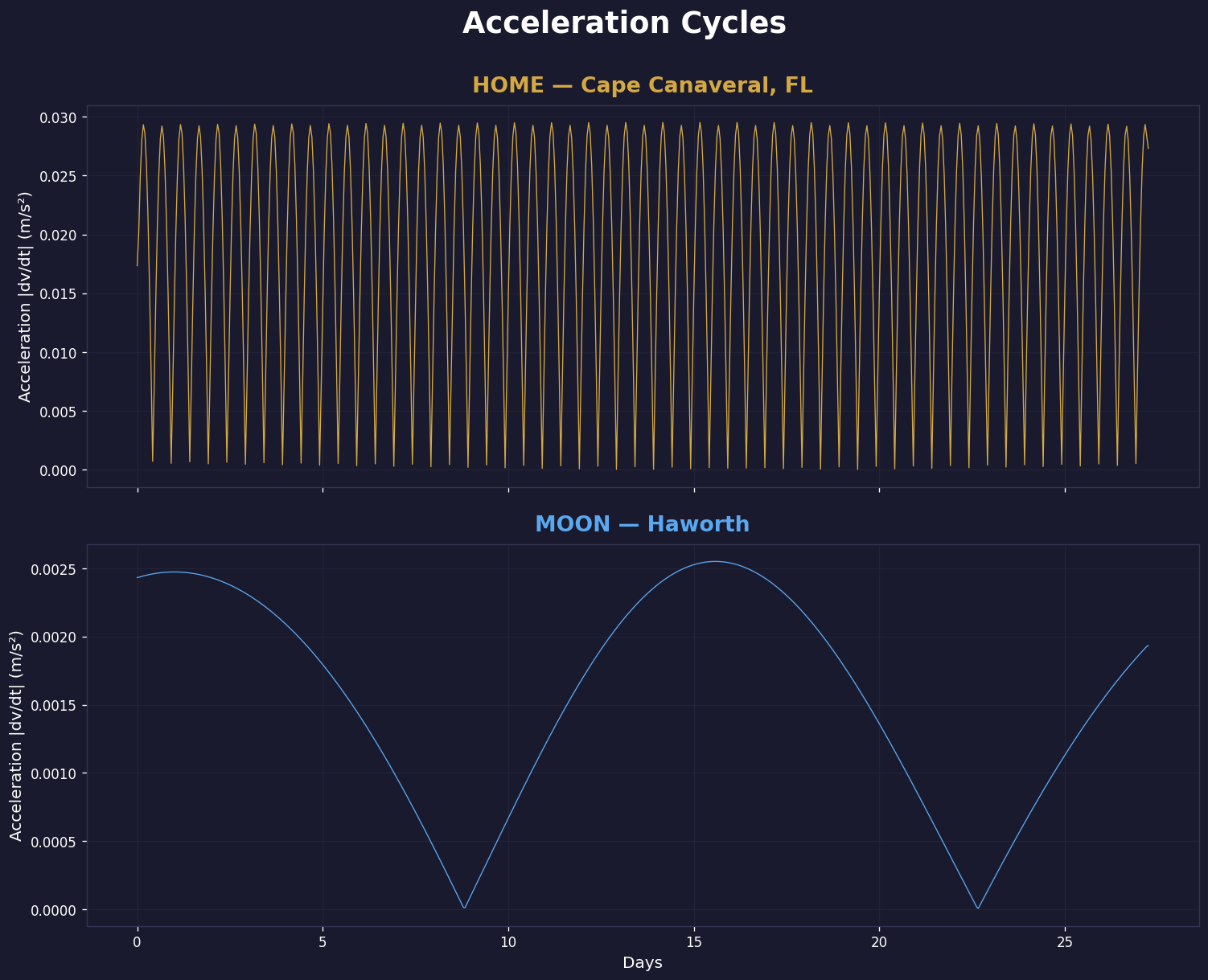
Net non-inertial acceleration. Earth's is ~4.1× higher and modulated by tidal cycles. The Moon's acceleration is dominated by the solar centripetal term with slow lunar-month variation.
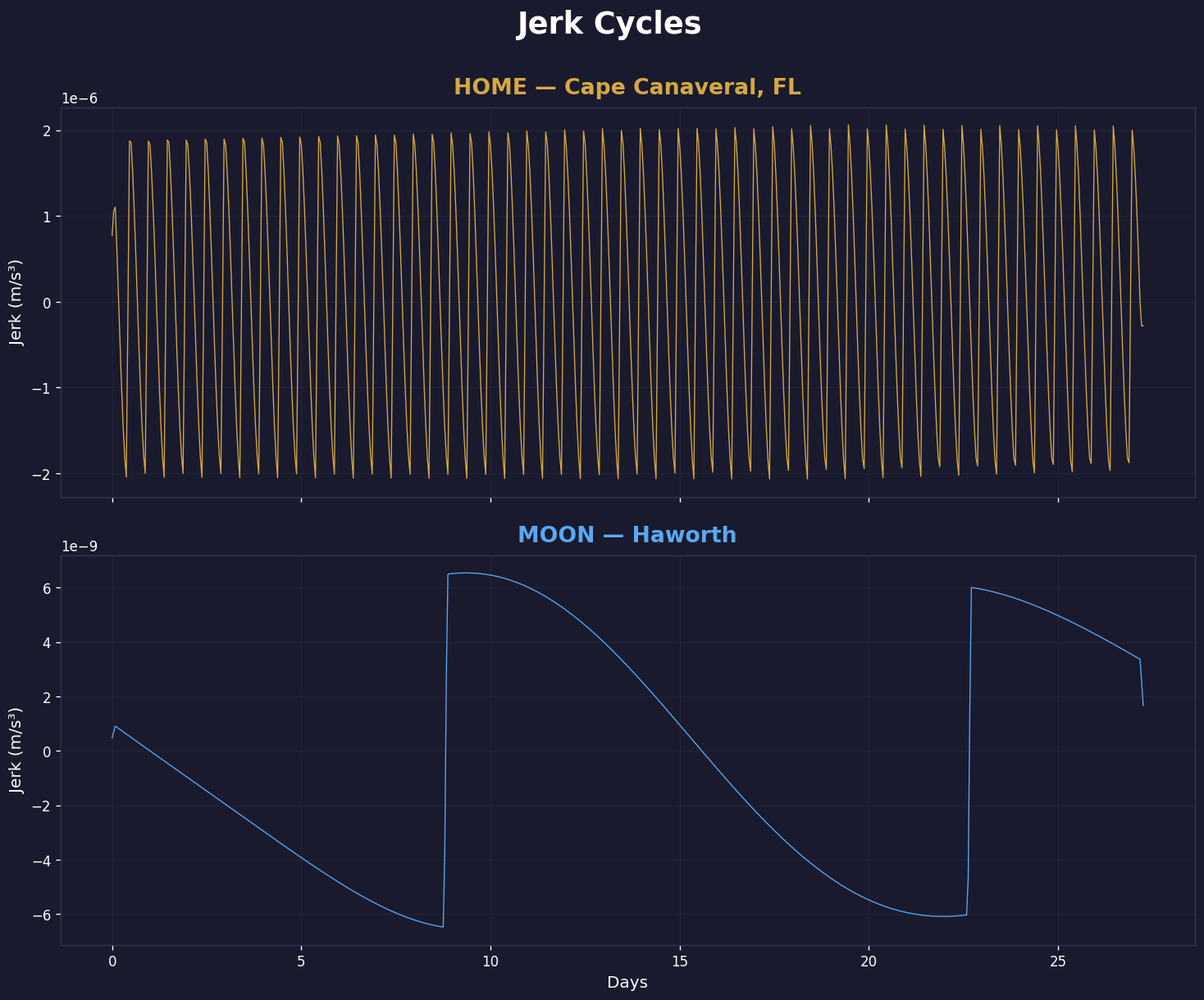
Jerk — the rate of change of acceleration. Earth's jerk is ~10× larger and oscillates rapidly. The Moon's jerk is a slow sinusoid. This quantity reflects the richness of the dynamic environment.
Biology doesn't know — and since no living organism has ever spent more than 3 days on the Moon (Apollo 17), there is no real data to assess. But what we do know is that when organisms are transplanted from the dynamic environment in which they and all other life have spent 4 billion years evolving with to one in orbit, their metabolisms become disrupted — all the way down to the level of their genomes. If our proteins, enzymes, and metabolic pathways evolved to utilize the strain signals associated with acceleration, jerk, and snap cycles inherent to Earthbound environments — not necessarily for driving bonding change but even just for cueing rhythms or priming bound states so they can more easily be pushed over fine-tuned energy thresholds — then any cell process tuned to these strain cycles has the potential to be disrupted.
What the plots above illustrate is that on Earth, a 68 kg body experiences strain cycles at multiple nested frequencies: a 24-hour spin cycle, 12-hour tidal oscillations, 27.3-day lunar modulation, and 365.25-day annual variation. These cycles beat against each other, creating a rich, time-varying dynamic tapestry. At the lunar south pole, the 24-hour cycle is gone and the spin period stretches to 27.3 days — identical to the orbital period (tidal lock). The rich daily rhythmicity that every organism on Earth evolved within simply does not exist.
Two key questions the Copernican framework raises for lunar habitation: 1) Do metabolic rates shift when the 24h spin-driven strain cycle is absent? and, 2) Does circadian gene expression adapt (or fail to adapt) to a 27.3-day "day"? For The Copernican Project, these are not speculative questions — we have active experiments designed to probe the connections between our dynamic environment and metabolic order. The week-long visits planned for the early Artemis missions may not reveal the full biological significance of these altered dynamics — but as NASA plans for sustained months-long stays at future Artemis Base Camps, the best way to ensure success is to either demonstrate that these dynamics do matter and begin engineering countermeasures, or establish experimentally that they don't and start the countdown.
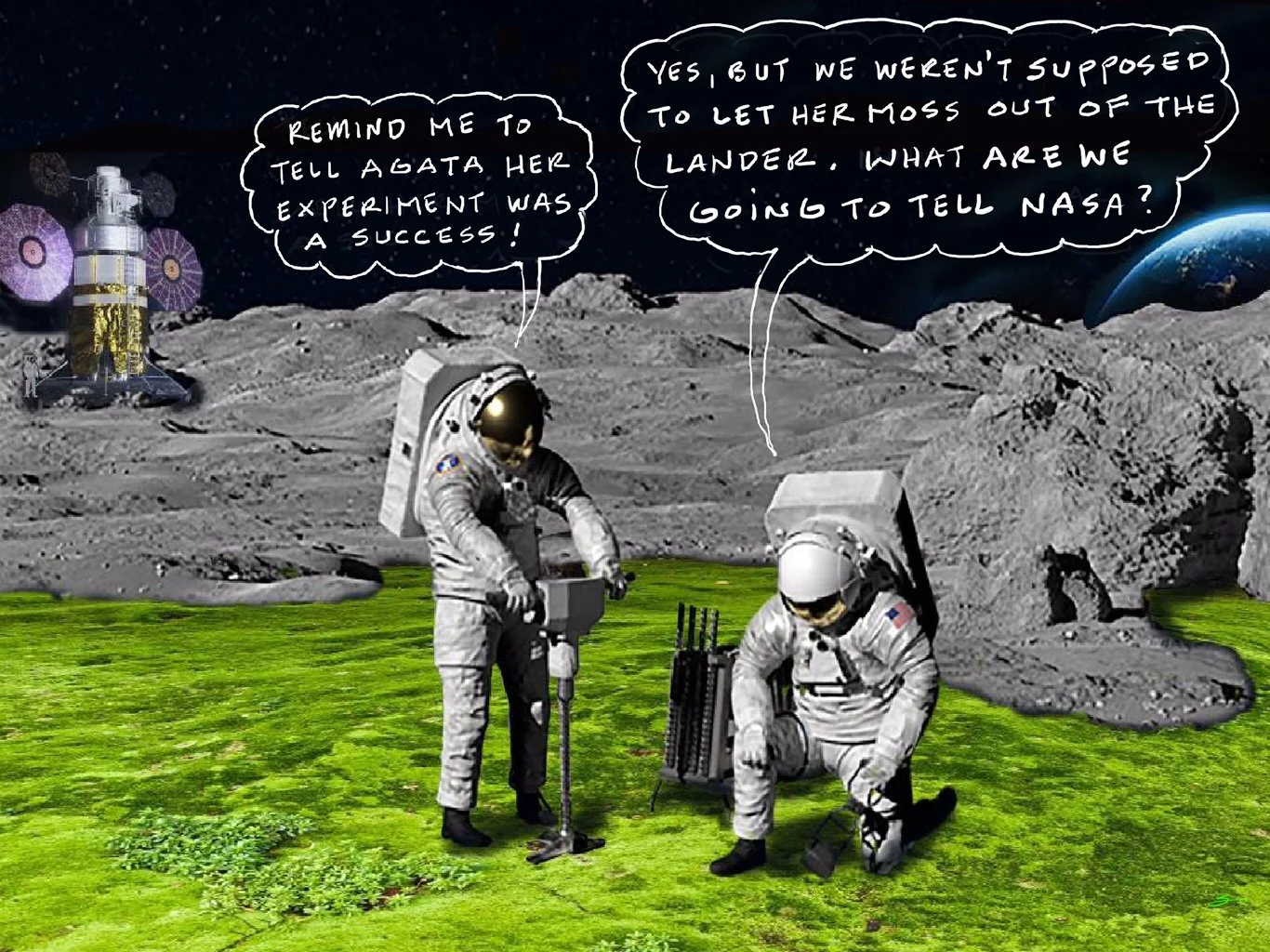
Our teammate Agata Zupanska, Principal Investigator and Research Scientist at SETI, studies radiation-tolerant moss species that could one day support lunar habitation. Her ISS-flown experiment, ARTEMOSS, tested moss tolerance of deep-space ionizing radiation combined with microgravity.
Read: Designing payload for plants from extreme environments › Frontiers in Space Technologies (2024)
Read: Moss Tolerance of Deep Space-Like Ionizing Radiation — BRIC-27 › NASA (2023)
Cartoon by Steve Thorne, 2024
The dynamics on this page were computed using EarthFrame (for Earth-bound profiles) and its companion module LunarFrame (for Moon-bound profiles), part of The Copernican Project's open-source toolkit. Both modules compute full non-inertial reference frame dynamics — velocity fields, accelerations, jerk, snap, and strain spectra — for any point on their respective surfaces. If EarthFrame can help you with your experiments, reach out to us and we'll help you integrate it into your program.